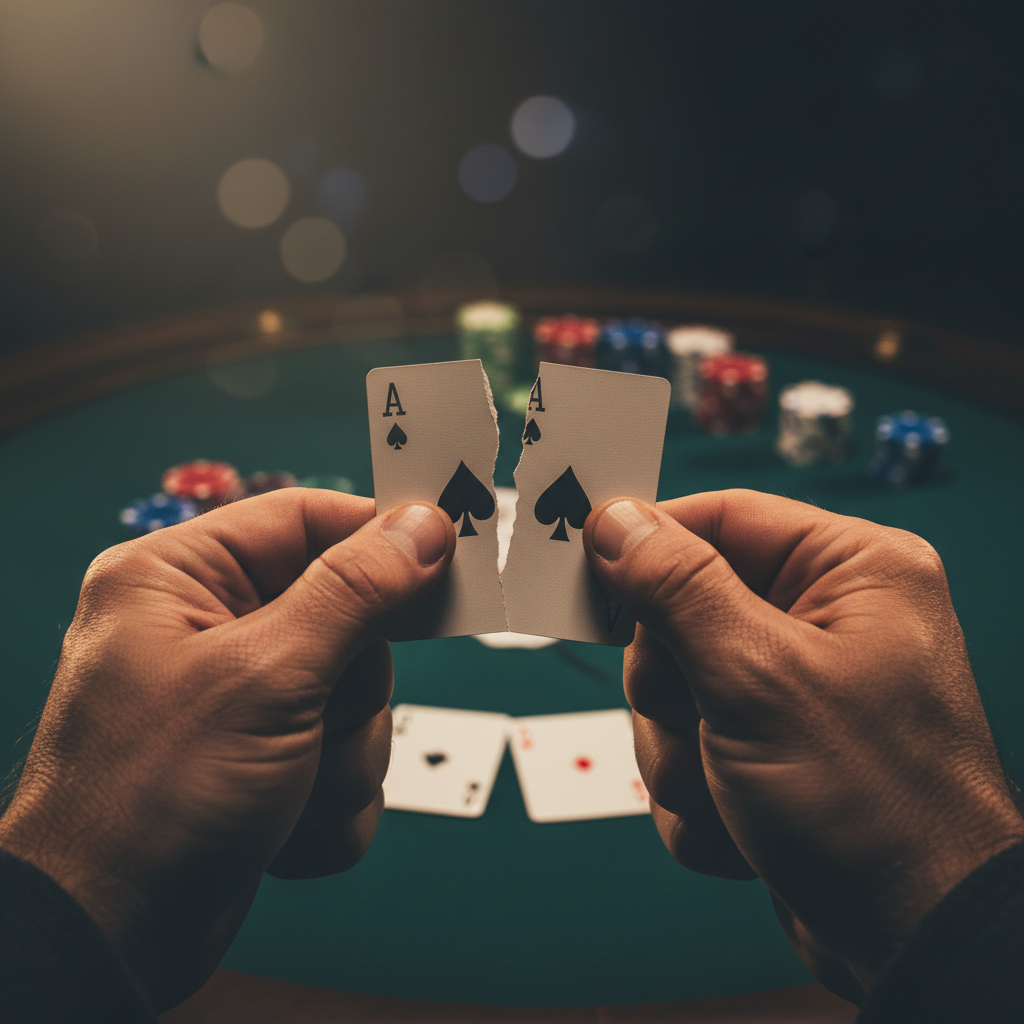
There is a belief, deeply held and widely repeated, that separates poker from "real" gambling. Slot machines are for suckers. Sports betting is a mug's game. But poker — poker is different. Poker rewards the patient, the disciplined, the psychologically astute. Poker is a skill game.
This belief is not entirely wrong. Skill does exist in poker. The problem is that the belief is used to justify behavior that the data consistently shows leads to financial ruin for the overwhelming majority of players. And for a significant subset of those players, it becomes an addiction that destroys marriages, careers, and lives.
This article is not written to shame anyone who plays poker. It is written because the skill-game narrative is one of the most dangerous rationalizations in problem gambling — and because understanding the truth is the first step toward making a free choice about whether to continue.
What the Numbers Actually Say
The most cited figure in poker communities is that approximately 70% of players lose money in the long run. But that estimate may be conservative. A large-scale analysis of online poker hand histories from 2005 to 2008 found that 90% of accounts were net losers over six million hands. Only 7% of players were consistently profitable. The remaining 3% broke even.
These are not recreational players who played a few hands and quit. These are regular players tracked over years of real money games. The conclusion is stark: if you play poker regularly over a meaningful time horizon, the probability that you are among the 7% of long-term winners is low — and the probability that you believe you are in that 7% is very high.
"Around half (46 per cent) of regular poker players — approximately 60,000 adults — experienced one or more gambling-related problems." — Australian Institute of Family Studies, 2018
That figure from Australia is particularly striking because it comes from a study of regular poker players, not problem gamblers identified through treatment programs. Nearly half of people who play poker regularly have experienced gambling-related harm. No other form of gambling studied in that research came close to that rate.
The Rake: Why Even Good Players Lose
The most misunderstood aspect of poker economics is the rake — the percentage of each pot that the house takes as its fee for running the game. In live casino poker, the rake typically ranges from 5% to 10% of each pot, capped at a set dollar amount. Online poker rooms take a similar percentage.
This may sound small. It is not. Consider the math:
| Player Skill Level | Win Rate Before Rake | Typical Rake Cost | Net Result |
|---|---|---|---|
| Recreational player | –$15/hour | –$10/hour | –$25/hour |
| Average regular | –$5/hour | –$10/hour | –$15/hour |
| Good player | +$10/hour | –$13/hour | –$3/hour |
| Excellent player (top 7%) | +$25/hour | –$13/hour | +$12/hour |
As poker coach Jonathan Little has noted: "If you are merely a good player and win $10 per hour before the rake, you will lose at the rate of $3 per hour despite having a decent edge over your opponents." The rake does not just reduce profits — it turns a winning player into a losing one.
This is the mechanism that makes poker, in practice, a negative-sum game for all but a small elite. The house does not need to beat you at the table. It simply takes its cut from every pot until the math does the work for it.
The Skill Argument: What It Gets Right and Wrong
The academic literature on poker and skill is genuinely mixed. A 2012 quasi-experimental study published in the Journal of Gambling Studies found that under certain basic conditions, poker should be regarded as a game of chance. A 2011 NBER working paper by economists Steven Levitt and Thomas Miles found evidence of skill among a subset of high-stakes players. Both findings can be true simultaneously.
Skill exists in poker. Elite players do outperform average players over large sample sizes. But several factors limit the practical relevance of this for most players:
| The Skill Argument | The Reality Check |
|---|---|
| Skilled players win consistently | Only ~7% of regular players are long-term winners |
| You can study and improve | So can everyone else — the competition improves too |
| Skill overcomes luck over time | Requires tens of thousands of hands — most players quit or go broke first |
| Poker is different from casino games | Problem gambling rates among poker players are the highest of any gambling type |
| I can read people and situations | Overconfidence bias is the most common cognitive distortion in problem gamblers |
The most dangerous aspect of the skill narrative is not that it is false — it is that it is partially true. Partial truth is far more seductive than outright falsehood. It gives the mind a foothold to rationalize continued play despite mounting losses: "I'm not losing because poker is gambling. I'm losing because I haven't mastered it yet."
How Poker Addiction Develops
Poker activates the same neurological reward pathways as every other form of gambling. The variable ratio reinforcement schedule — unpredictable wins interspersed with losses — produces the strongest and most persistent dopamine response known to behavioral psychology. The fact that some of those wins are attributable to skill does not change the neurological response. If anything, it intensifies it: the brain attributes wins to competence and losses to bad luck, creating a self-reinforcing illusion of control.
Poker also has several features that accelerate addiction risk specifically:
- Session length: Unlike a slot machine spin that takes seconds, a poker session can last 8–12 hours, making it easier to lose track of time and money.
- Social environment: The camaraderie at the table creates a social reward that exists independently of the gambling itself, making it harder to walk away.
- The "bad beat" narrative: Losing due to a bad beat (statistically unlikely loss) provides a ready-made excuse that protects the ego and justifies returning to play.
- Accessible online play: Online poker is available 24/7, removing the natural friction of traveling to a casino.
The Faith Perspective: Skill, Stewardship, and Freedom
For men of faith, the poker question has a dimension that statistics alone cannot address. The question is not only "Can I beat the rake?" but "What am I doing with the resources, time, and mental energy God has entrusted to me?"
Proverbs 13:11 speaks directly to this: "Wealth gained hastily will dwindle, but whoever gathers little by little will increase it." The pursuit of fast money through games of chance — regardless of the skill component — runs counter to the biblical model of patient, faithful stewardship.
"The thief comes only to steal and kill and destroy; I have come that they may have life, and have it to the full." — John 10:10
Gambling addiction, in the testimony of thousands of men in recovery, is precisely this: a thief. It steals time from families, money from savings, presence from marriages, and peace from the mind. The skill-game narrative is one of the tools it uses to maintain its hold.
Recovery from poker addiction follows the same path as recovery from any gambling disorder: honest acknowledgment of the problem, removal of access, professional support, community accountability, and the slow rebuilding of a life oriented around genuine meaning rather than manufactured excitement.
If You're Wondering Whether You Have a Problem
The Australian Institute of Family Studies research found that nearly half of regular poker players experience gambling-related harm. If you play poker regularly, the following questions are worth sitting with honestly:
- Do you spend more time thinking about poker than you intend to?
- Have you ever lied to someone about how much you play or how much you've lost?
- Do you return to the table to win back money you've lost?
- Has poker ever caused conflict in your relationships or affected your work?
- Do you tell yourself you'll stop after the next win — and then don't?
If you answered yes to two or more of these questions, the National Problem Gambling Helpline is available 24/7 at 1-800-522-4700. The call is free, confidential, and staffed by trained counselors who understand the specific dynamics of poker addiction.
The skill is real. The trap is also real. Knowing the difference is what freedom looks like.
If you or someone you know is struggling with poker or gambling addiction, the National Problem Gambling Helpline is available 24/7 at 1-800-522-4700.